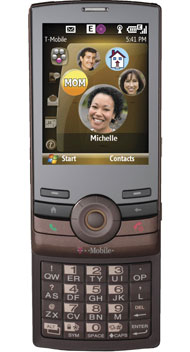
 David Pogue, New York Times consumer tech writer, has written a candid article first praising and then trashing the T-Mobile Shadow.
Pogue outlines the newish environment created when T-Mobile and an ex-Apple designer partner to design a device with some great innovative features and then taken the third-party manufacturer (apparently HTC is the manufacturer, if ZDNet is correct) out of the picture and designed their own device; rethinking a few key features. The list of praise is impressive including a rethought click-wheel for scrolling plus directional buttons for up, down, left, right selections and a Blackberry Pearl style keypad licensed from RIM. But then, Pogue says, “you turn it on.” You see, its fatal mistake is it’s running Windows Mobile 6.
Pogues’ rant reminds me of my own review of the Windows Mobile 5 Samsung Blackjack.
Add this to digg, del.icio.us, etc.
We like when the mainstream press highlights the right things. It’s a signal that the non-insiders might get a sense of the pains and frustrations felt in the mobile industry. Who else but Walt Mossberg could deliver it to the bad guys with WSJ credibility. Mossberg’s axis of evil includes Steve Jobs’ inked deal with “the devil,” (read the piece to see who that is), it includes 1970s-era AT&T, and the top US carriers whom he calls collectively the Soviet ministries.
My only suggestion for Mr. Mossberg is that he up the production value of his video studio. He speaks with the eloquence of someone who has a speech writer (presumably himself) but his close-up cam, with low quality video comes off a bit like a YouTube “video response.” But, hey, maybe that’s the best way to get heard these days.
Read or watch Mossberg’s Free My Phone rant at All Things D.
Add this to digg, del.icio.us, etc.

This is a real text message from Cingular. (I’m sure my phone is in their database from last season when my daughters voted for Ms. McPhee.)
But, I couldn’t believe this jumble of text. I have no doubt 16 year olds could probably understand it… but I question whether that still makes it smart marketing. Does bad language and incoherent punctuation add street cred? Do they do it because they believe users won’t scroll?
The haphazard punctuation — sometimes a comma, sometimes a period, sometimes nothing — is the icing on the cupcake. Why push the boundaries of language this far into the downright ludicrous? Are they trying to cut character count to save on data transfers? I don’t get it.
Add this to digg, del.icio.us, etc.
There has been a lot of press and commentary on Apple’s iPhone. Deservedly so. From what has been presented thus far the iPhone is a sleek piece of hardware and software engineering as only Apple can produce it. Whether the iPhone is revolutionary, expected or somewhere in between, the discussion has focused primarily on the device’s features and interface. Much less has been said about the implications of Apple’s iPhone business strategy. Since the iPhone was announced on January 9, my thoughts have turned to the decisions that Apple has had to make in order to enter the wireless market and what may come in the wake of the iPhone’s June 2007 launch.
Why iPhone?
Apple’s decision to get into the wireless device business is not surprising. Since the launch of the iPod 5 years ago, Steve Jobs has touted the connected experience where all Apple devices and services work and play seamlessly with one another in one glorious digital ecosystem. Since the mobile phone has become the one device that no one is ever without, despite the fact that nothing about the wireless experience is very good, it was only a matter of time before Apple got into the game. “Everybody hates their phone,” Time magazine quotes Jobs as saying, “and that’s not a good thing. And there’s an opportunity there.”
Uncharted Territory
Having decided to get in the game, Apple’s most significant decision is to be a manufacturer only rather than a manufacturer + MVNO. This is curious since Apple’s brand is largely based on its control of the end-to-end consumer experience. The MVNO route would have allowed Apple to maintain the most control over the end-to-end iPhone experience, clearly important after the ROKR fiasco. However, it would also have taken Apple into uncharted territory as a wireless operator. With iPhone v.1 Steve Jobs has decided to take the path with the fewest risks and stick with what he knows Apple does best.
Continue Reading »
Add this to digg, del.icio.us, etc.
“Cool, no hard hard keys!” versus “Are you kidding? No keyboard?”
First, I’m not deluded enough to think the iPhone is the holy grail of devices. They have a lot in their favor in the US, but they don’t have a smooth ride like they did with the iPod.
If you read the US blogs and tech papers, the iPhone is best thing since the personal modem. Glowing headlines like Apple Waves its Wand at the Phone, where David Pogue equates Apple to a fairy godmother, to “It’s Expected, but it’s Stunning” from the SF Chronicle.
But if you read what the Europeans and Asians are saying, this is cool, but not worth all the hype. Russell Buckley even says it’s just a music phone. Then there’s the LA Times story: “In Japan, Barely a Ripple”, which is saying that all these features (plus mobile payments) have been available in Japan for 2+ years already. (But come on, they haven’t thrown out cumbersome soft keys in exchange for full-face, multi-touch screens, have they?)
So, what is it? Is it just a music phone?
Continue Reading »
Add this to digg, del.icio.us, etc.
The web is blowing up today with content on the new iPhone. It seems everyone has a perspective, and I’m no different.
Revolutionary or not, Apple did a few things right with this iPhone debut, which I’m convinced will resonate with today’s mobile users.
Portrait-landscape orientation: As media enjoyment and management grows on the mobile platform, mobile users have had to accommodate that awkward moment when you have to physically pivot the handset in your hands in order to view an image or watch mobile TV. In those instances, there is often a sense of disorientation while the user remaps expectations for the D-Pad, and explores how to interact with softkeys, etc. By creating a device that orients itself and keeps tactile interactions consistent, they’ve created a device that feels native to both orientations.
Continue Reading »
Add this to digg, del.icio.us, etc.
I’ve tried to separate myself from my Apple fetishism, and slough off Jobs’ reality-distortion effect and really assess this mornings’ announcement from the perspective of it’s impact on mobile user experience. (Certainly, a true UI critique will occur once we can get a device in hand in *sigh* June.
At the end of his keynote this morning, Steve Jobs summed up Apple’s mobile strategy saying, “There’s an old Wayne Gretsky quote I love — ‘I skate to where the puck is going to be, not to where it’s been.’” Which felt apropos given the product they had just announced. But, is the Apple iPhone announcement truly a “revolution of the first order?”
My take is that this is not a revolution for mobile phones. No, it feels more like catching up in a major way in an industry that has been behind far too long. Features like push email are best practices (read: Blackberry), not revolutionary. Integrating mail, voicemail, sms, contacts, voice calls, photos, music and video is also not revolutionary, but Apple is able to realize it where others have not.
Continue Reading »
Add this to digg, del.icio.us, etc.
The following was my response since I couldn’t let Jared have all the fun. This question was asked a few days ago on the Adaptive Path blog.
It’s a broad question, but I think it’s really about whether Apple can launch a successful music phone. The iPod is the perfect music player and people are cheering Apple in hopes to get the perfect phone.
The current industry model of carriers and OEMs partnering to create a compelling music phone has had pretty limited success — for example, even though the Motorola ROKR partnered with Cingular to bring Apple’s iTunes and was marketed in unprecedented ways it was what basically a flop by Motorola’s standards because it failed on it’s primary promise to be a music phone. (Engadget reported that 1 in 6 ROKRs got returned). That carrier/OEM dynamic is possibly what’s at stake if Apple succeeds.
Consider this: with ringtone sales on the decline (which is a first in the US), carriers are the ones who stand to lose on the R&D spent developing a music phone offering (since they won’t get paid from data and music sales if everybody’s side-loading their music ala the iPod method). It’s the handset manufacturers (OEMs) that serve the carriers, and these OEMs are the ones who stand to gain from a hot handset that could deliver a compelling music experience.
Continue Reading »
Add this to digg, del.icio.us, etc.
In a video interview, Helio’s CEO describes mobile life beyond phone calls. He goes into the Helio strategy which focuses on a target market who is already thinking beyond voice. He doesn’t go that deep into specifics (what CEO ever does?) but it seems like MySpace will be the biggest content partner for Helio.
I think we’ll know the whole “beyond voice” idea has fully arrived when cellular commercials stop talking about minutes and networks.
(Also worth checking out… A CNET editor demonstrates the new Helio device.)
Add this to digg, del.icio.us, etc.