Archive for the 'UI Technologies' Category

Idlemode

Nokia to Make Symbian Open Source

Nokia Pushes Symbian OS into the Ring with Google’s Android

Symbian LogoThe Financial Times is reporting that Nokia will buy the rest of Symbian and unveiled its plans to make the smartphone OS open source in 2009, under a newly formed Symbian Foundation. Nokia’s move counters the Google-led Open Handset Alliance and its Android platform.  

From the article: “The world’s largest handset maker announced it was taking control of Symbian, the UK software company responsible for the most popular operating system on smartphones.

“Nokia will contribute the computer code behind Symbian’s operating system to a new non-profit organisation to be called the Symbian Foundation. The foundation will make the code available for free to software developers, in a move aimed at spurring innovation in the mobile internet.

Joe Pemberton

User Experience Critique: HTC Touch Diamond

HTC Touch Diamond: Your Windows Mobile is Showing

In March I posted HTC’s beautiful promotional video of the Touch Diamond UI. Now that the device is commercially available (in the UK for now) we can see the interface design in action. In a fairly in-depth video the mobile bloggers at TracyandMatt.co.uk run the UI through its paces.

The UI belies the Windows Mobile 6.1 OS underneath — it is nowhere apparent in HTC’s official video. But the problem isn’t necessarily Windows Mobile as the HTC UI does a great job at hiding it. The problem is the gaps they left in the Touch Diamond UI that let the Windows Mobile core UI poke through. The result is a disjointed experience as the user bounces between what seems like a solid, gestural and accelerometer-enabled touch experience and back to the basic and ugly Windows Mobile UI. As you can see from the video, there are clearly breakdowns in the experience where the new HTC UI behaves differently from the Windows Mobile underneath.

This is a case study of the fragmentation in the go-to-market (commercialization) process. The device manufacturers, the carriers and the operating systems come from different places with different motivations and business models. The parties involved are never fully able (despite what seems to be a really fantastic effort from HTC) to make that industry fragmentation invisible to users.

The video illustrates some of the noteworthy gaps in the user experience. Play by play after the bump…

Continue Reading »

Joe Pemberton

Adobe Open Screen Project

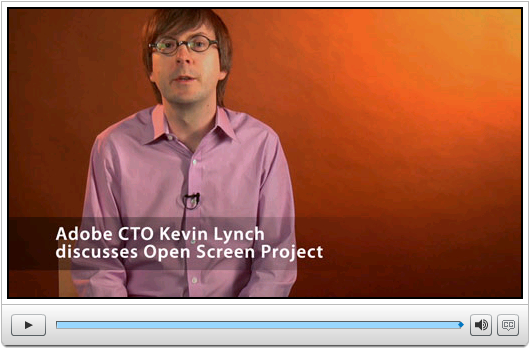
Adobe CTO Kevin Lynch - Idlemode

Adobe CTO Kevin Lynch discusses the Open Screen initiative and explains the reason for the discontinued licensing requirements for using SWFs in the mobile platform. Also of great interest to those reading between the lines, Kevin describes the AIR (Adobe Integrated Runtime) initiatives with the phrase “desktop and devices”. We’ve been left to speculate about “AIR Lite” since none of our contacts at Adobe will spill any details. In essence though though an AIR Lite offering would allow Flash apps to run on mobile devices outside of a browser.

Qualcomm Adobe BREW FlashBREW 2008, SAN DIEGO –  Adobe and Qualcomm announced Flash would be fully integrated into the BREW Mobile Platform. The news was the latest in a string of great announcements about the platform that are taking the BREW and the Flash Lite communities by surprise. Last week’s announcement came on the heels of some great developments on the Flash front with Sony Ericsson announcing all its future handsets will be Flash enabled and with Adobe’s announcement that licensing the Flash player will be free (meaning other handset makers are likely to follow).

Qualcomm and Adobe are partnering to create, or rather revamp, Qualcomm’s BREW Mobile Platform. For an Adobe perspective Read Bill Perry’s overview on his FlashDevices blog. Technically, BREW already was a mobile platform to begin with, but in the wake of the iPhone and possible Android disruptions, it’s not surprising this has been in the works. These companies are looking for partners to create platforms and alliances to ensure their competitive edge. Could this mean that we will see AIR mobile (Adobe Integrated Runtime) soon? And if so, will it cooperate with this new BREW Mobile Platform?

The Adobe Flash Lite player has been available as a BREW application (BREW engineers call it an extension) for almost 2 years — but in its current state, it allows Flash Lite applications to run only as siloed downloads (for games, screen savers, visual ringtones, etc.). There was no good way to use Flash Lite for anything other than tiny apps, unless you had the full support of Adobe in helping you write a custom player for your platform of choice. In addition, it was clear Adobe did not have plans to port Flash Lite 3 to the BREW platform as a BREW app.

Fast forward to now… Continue Reading »

Joe Pemberton

HTC Touch Diamond Interface

HTC has released a promotional video of the new HTC Touch Diamond user interface. The device boasts touch input and an accelerometer with HTC’s TouchFlo 3D rendering. The Windows Mobile 6 device will hit shelves any week now in the UK. The product is slated for the US later this year.


Joe Pemberton

Sun Unveils JavaFX Mobile

Sun JavaFX Android PrototypeAt last years’ JavaOne conference Sun Microsystems announced its entry into the presentation layer technology race. JavaFX Mobile will compete with Qualcomm’s uiOne, Adobe’s Flash Lite and Microsoft’s SilverLight.

From the AndroidGuys blog “…Earlier this week, Sun announced details for the forthcoming JavaFX Mobile and even demonstrated it with an Android prototype. Targeting multimedia phones, it will be part of a few planned JavaFX stacks due from the company. Typically, most phones running Java rely on the language for user-installed applications. For JavaFX Mobile however, it will have Java running behind everything from the user interface (UI) toolkit to the telephony, media, and browser software. Ideally, you’ll have the same experience with desktops, mobile devices, set-top boxes, and even automobile dashboards.”


Ben Wigton

Flash on the iPhone — The Facts

Adobe’s investor relations call this week discussed the question of Flash for Apple’s iPhone. Get the inside information from Adobe’s Flash evangelist, Bill Perry.

I’m discovering more and more that it’s not the user experience groups within the carriers and handset manufacturers that we need to convince about a new interface innovation; it’s the chipset manufacturers. While the vision and promise of a given UI might grease the necessary wheels of approvals to get an innovation to market, it rarely arrives without a degree of compromise.

Idlemode: Sony Ericsson XPERIA
Take the Sony XPERIA X1. In this highly-polished pitch video, the UI shucks and jives with all the agility of motion graphics at their finest. And sure, it works. For a UI that relies on a simple 3-view switcher to differentiate, it does make for a unique mobile experience. It certainly is more interesting than a lot of phone UIs out there. However, the actual device experience does lack in the speed department. The experience becomes even more painful when navigating the arched carousel, as demonstrated in this video.

Idlemode: Sony Ericsson XPERIA

Are companies hoping simple-minded consumers won’t notice these details? Unfortunately, in this example, an interesting UI transition has now become something that many users can’t help but notice — and wait for — every time they switch modes. Despite the fact that this is largely driven by the processor’s ability to push the objects around screen, this is the very stuff that perpetuates the stereotype that visual designers are all about gratuitous graphics at the cost of UI efficiency.

Sony XPERIA, marketing video:
http://www.youtube.com/watch?v=Ay7RMHcUuGQ

Sony XPERIA, hands-on at 3GSM:
http://www.youtube.com/watch?v=wuo9CAZCbIE
http://www.youtube.com/watch?v=4wU5eiMR57s

Christian Robertson

Symbian in denial over Android

Symbian seems to be in the first stage of grief over Android, Google’s new operating system for mobile. From an article by the BBC: “Google’s dominance of the web will not translate to the mobile phone market, a senior executive at Symbian has said.”

From the Symbian exec:
“About every three months this year there has been a mobile Linux initiative of some sort launched.

“It’s a bit like the common cold. It keeps coming round and then we go back to business. We don’t participate in these full stop. We make our own platform and we are focused on driving that into the mobile phone market at large ever more aggressively.”

And two paragraphs later:
“Meanwhile, the head of Nokia in the UK said the firm was in discussions with Google about using the platform.”

Read the BBC News article.

Link via Slashdot.

Joe Pemberton

Google Android: What does it mean for users?

The tectonic plates under Earth’s crust are moving very slowly all the time. Yet, we only notice them when enough tension builds up and there’s an earthquake. (Yes, I’m in California, and yes we had a 5.3 the other day.) The analogy applies to the dynamic you get in the mobile industry where there’s progress being made all the time, but where it’s easy to just wish it happened sooner. The trend is moving toward openness and toward user choice, but we don’t feel it until someone makes a big announcement like Google’s this week.

The shift is happening, and thankfully it’s happening faster than plate tectonics. Apple’s iPhone launch was a big deal, proving that a device manufacturer can play first fiddle in the US mobile industry (and AT&T isn’t complaining that 40% of iPhone buyers are new subscribers) and more importantly, proving that a device’s user experience can lead every part of the conversation; within the industry and with consumers.

Google’s announcement feels like a corollary to Apple’s. It adds evidence that a non-carrier can wrangle support from across the mobile industry (handset and chip OEMs, carriers, platform developers) to create an open platform.

Google’s announcement has interesting possibilities. What will device manufacturers come up with if they don’t have to pay Microsoft (or anybody else) for their OS? What will the carriers create if they didn’t have to pick from the pros and cons of the various OSs, but if they had the ability to write their own branded UI for a line of devices? What will the third party application developers be able to do with a more open, internet-powered approach (as is starting to happen on the Apple front, but that’s another debate.) What will content providers create for users if Google can prove an ad-subsidized mobile model will work?

Someday we’ll all look back and remember how cute Google was when it was just a little rainbow logo search field staring at you from a blank page.

Next »